







Active vs Passive FIBC Grounding for Type C Bulk Bags
A practical comparison of passive FIBC Type C grounding and active monitoring, including resistance verification, standards alignment and safer hazardous location bulk handling.
Active FIBC grounding uses monitored two-point continuity and resistance checks to confirm that a Type C FIBC remains connected to verified ground during filling or emptying. Passive FIBC grounding uses a clamp and cable, but relies on visual checks and does not confirm resistance.
In this article, “grounding” and “earthing” refer to the same electrostatic control principle: connecting the Type C FIBC to a verified ground or earth point so static charge can dissipate safely.
Is active or passive FIBC grounding better?
The short answer is that a monitored electrostatic grounding connection does everything a passive connection does, but better, meeting the requirements of the standards and making for easier, safer bulk material processing operations. For a longer answer, read on…
Clamp and cable only
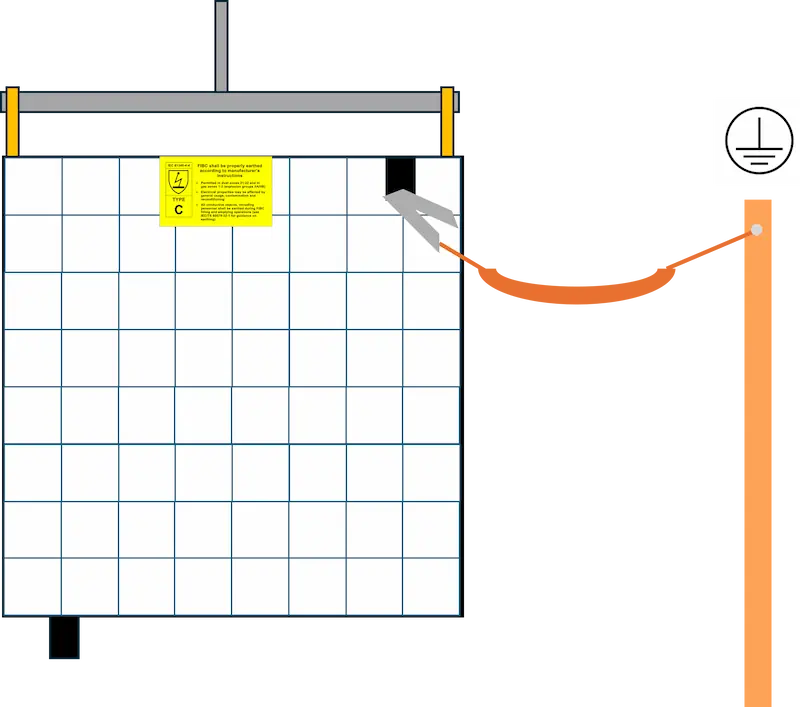
Passive grounding connects a Type C FIBC to ground using a clamp and cable. It can establish a direct path to ground, but provides no active confirmation that the connection is effective, continuous or within the required resistance threshold.
Monitored connection
Active grounding continuously verifies the connection to ground before and during operation. It monitors resistance, provides a clear "GO/NO-GO" status and can alert operators or interlock with equipment if grounding is lost.
Why Type C FIBCs need electrostatic grounding
When carrying out processing operations such as filling and emptying Type C FIBCs with flammable bulk materials, electrostatic charge can be generated and, if not controlled, can become an ignition source that leads to a risk of fire or dust explosion.
The best way to prevent this accumulation of electrostatic charge is to set up an electrostatic grounding connection before and during process operations. This can be done with a simple passive grounding solution or a more comprehensive active grounding solution.
For Type C FIBC operations, the important question is not simply whether a clamp is attached. It is whether the bulk bag is confirmed as connected to ground before and during transfer.
Key article insight- Charge can be generated during normal operations as bulk materials move through process equipment and against the FIBC surface.
- Static discharge may be invisible until it becomes hazardous, particularly where flammable gases, vapours or combustible dust atmospheres are present.
- The grounding path needs to remain reliable throughout filling and emptying, not just at the start of the task.
What is passive FIBC grounding?
The main benefit of a passive grounding solution is that it is simple. A direct connection can be made from a Type C FIBC to a local site grounding point via a clamp and cable.
The passive connection uses a single point of contact and must be visually checked by the operator to ensure that it remains in place throughout operations. If a high-quality clamp and cable are used, a reliable connection between this point and the site ground can be established, but the connection would only be between these two points, and the operator would have no confirmation of whether the entire bulk bag is safely grounded, or how high the resistance is between the bulk bag and the grounding point.
What is active FIBC grounding?
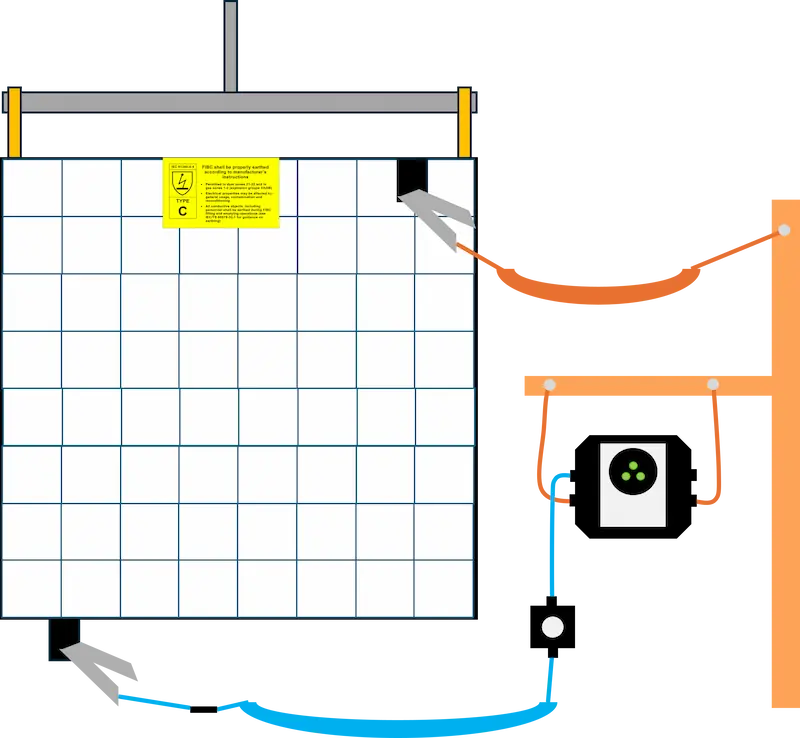
An active electrostatic grounding solution takes the benefits of a passive solution and improves on them. By using two points of contact at the top and bottom of the Type C FIBC, an active solution can monitor across the material of the bulk bag and form a closed loop back to the site grounding point.
This helps to mitigate the risk of the contact point or another part of the bulk bag becoming isolated from ground. The active monitoring loop also allows visual indication to be given to the operator when the system detects that safe conditions are met and gives a permissive signal.
With the use of a permissive signal, an active electrostatic grounding solution can use output contacts to interlock with process equipment. This allows additional safety features such as audible and visual indicators when a good connection is made, or automatic shutoff if a connection is disrupted.
Even better, the use of an active electrostatic monitoring system allows sites to meet and demonstrate that they are meeting the requirements of the relevant safety standards and industry best practice.
GO/NO-GO indication
Operators receive a clear visual signal before proceeding with transfer operations.
Resistance verification
The system monitors to the maximum resistance threshold used for Type C FIBC grounding.
Process interlocks
Output contacts can be integrated with process equipment where the site design allows.
How active monitoring supports ATEX, IEC and NFPA expectations
The requirements for electrostatic grounding for Type C FIBCs are set out in national and international standards and industry best practice.
ATEX workplace safety directive
The European ATEX workplace safety directive sets out an obligation to avoid the ignition of explosive atmospheres where they occur during industrial hazardous location operations. This includes controlling and mitigating the risks of any possible ignition sources during FIBC transfer operations, including the buildup of electrostatic charge which can cause a spark discharge if not controlled.
This requirement can be met by a passive electrostatic grounding solution assuming that a good connection is established and maintained and can be confirmed to be met with the use of an active grounding solution.
IEC TS 60079-32-1 Technical Specification
The IEC technical specification IEC TS 60079-32-1: Explosive atmospheres - Part 32-1: Electrostatic hazards, guidance gives specific guidance that Type C FIBCs are to be connected to ground during filling and emptying operations.
Again, this requirement can be met with a passive solution assuming that nothing complicates or disrupts the connection and can be confirmed to be met with an active solution which continuously monitors the connection to the site grounding point during operations.
NFPA 77 and IEC 61340-4-4 Standards
The NFPA’s recommended practice NFPA 77 Recommended Practice on Static Electricity, along with the international standard IEC 61340-4-4: Standard test methods for specific applications - Electrostatic classification of flexible intermediate bulk containers (FIBC) – which has been adopted globally, forming the basis of national standards including the German DIN EN IEC 61340-4-4 and British BS EN IEC 61340-4-4 – along with the US recommended practice NFPA 77 are aligned in their further guidance that an electrostatic grounding connection of this kind “shall have a resistance to groundable point of less than 1.0 x 10⁸ Ω”
This requirement for a monitored connection with a maximum resistance value to the site grounding point is the key distinction between a passive and an active electrostatic grounding solution.
A passive electrostatic grounding solution must rely on an assumption that a visually inspected connection to ground is good enough, with no confirmation of the resistance. Meanwhile, an active electrostatic grounding solution which continuously monitors to a maximum resistance threshold of 1.0 x 10⁸ Ω gives ongoing confirmation that the requirements of the standards and best practice are being met, and can give both a clear visual indication to operators of the system’s permissive state, and interlock with process equipment to allow automation of additional safety features, further increasing process safety and reliability.
For more context, see Newson Gale’s static electricity safety standards and guidelines and the Type C FIBC application guidance.
What are the benefits of active monitoring?
In addition to improving process safety and conformance to standards and industry best practice, there are a number of other benefits provided by active electrostatic grounding solutions.
FIBC Bulk bag Condition
As with any other reusable item, over the course of reuse Type C FIBCs are subject to wear and tear. While there is as yet insufficient data for a meaningful answer to whether the direction of entropy can be reversed in general, one way that the risk posed by FIBCs in deteriorating condition can be mitigated is to use an active grounding system.
With the use of a continuous ground monitoring loop passing through two points of contact and across the fabric of the bulk bag, an active grounding system can flag to operators if this loop is disrupted due to a break in continuity. Under such conditions, a FIBC might outwardly still look serviceable, but in fact have sections which due to wear and tear have broken down and become isolated from the rest of the bulk bag, which could allow for electrostatic charge to build up if transfer operations were to continue.
Therefore, by not going permissive on a bulk bag suffering from wear and tear of this kind, an active grounding solution can catch a safety issue which would not be visible to the naked eye or to a passive grounding solution, allowing for the problem to be fixed before operators or facilities were put at risk.
Alignment with SOP and Training
Another benefit of an active grounding solution is to align with and support site standard operating procedures (SOP) and training.
It is important to distinguish here that aligning and supporting does not mean that an active grounding solution can or should replace robust SOPs or training for operators. There is no substitute for effective SOPs and trained and competent operators for carrying out safe and reliable hazardous location operations.
Instead, the use of an active grounding solution can help to support the trained and competent operators in the carrying out of their duties in a safe and consistent manner. This can include integrating the operation of the grounding system in a process check list (attach clamp – confirm green light – proceed with transfer operation), save time and site electrician callouts by having clear confirmation of safe grounding conditions, and help to support with internal and external audits for process safety (are we following NFPA 77? Is the grounding system being used? Yes to both).
In short, using an active electrostatic grounding solution allows trained and competent operators on well-run sites to carry out their responsibilities with increased safety and efficiency.
Active vs Passive FIBC Grounding: Key Differences
| Criteria | Active electrostatic grounding | Passive electrostatic grounding |
|---|---|---|
| Connection method | Two-point monitored connection across the Type C FIBC and back to the site ground point. | Single clamp-and-cable connection between the FIBC and a local grounding point. |
| Verification | Continuously monitors safe grounding conditions and resistance threshold. | Visual check only that the clamp is attached. |
| Operator feedback | Clear "GO/NO-GO" indication before and during the process. | No active status signal; the operator must rely on inspection. |
| Standards support | Conformance to NFPA 77, the ATEX workplace safety directive, IEC TS 60079-32-1, and IEC 61340-4-4. | Assumed conformance to some standards, no confirmation of conformance to NFPA 77 and IEC 61340-4-4. |
| Process interlocks | Can interlock with equipment for increased safety and process automation. | Operator control of all equipment. |
| Bulk bag condition insight | Early detection of problems with bulk bag condition. | No indication of condition of bulk bags. |
| SOP and training support | Support for SOPs and operator training. | Limited support for SOPs and operator training. |
Need monitored Type C FIBC grounding?
Newson Gale’s Earth-Rite® FIBC is designed to actively monitor the resistance through Type C bulk bags and provide clear "GO/NO-GO" indication for operators.
A safer answer to a simple question
Electrostatic grounding of Type C FIBCs is required for safe hazardous location bulk material transfer operations. While a simple passive grounding solution is better than nothing at all, there are some significant limitations to such a solution which can either leave operations open to unmitigated risks, or require significant further investment of time, effort, and money, to make up for gaps in the process.
Conversely, an active electrostatic grounding solution which monitors to the maximum resistance threshold of 1.0 x 10⁸ Ω provides a more comprehensive, safer solution which conforms to the requirements of the relevant standards and industry best practice, and supports trained and competent operators in carrying out safer, more efficient, and more reliable hazardous location transfer operations.