






Static grounding for railcars
In a typical railcar loading operation, the static accumulating product is transferred from a storage tank via a gantry loading system into the receiving railcar.
As the product makes its way through the transfer system to the railcar, the molecules in the product become electrostatically charged.
If the railcar does not have a direct connection to earth, it will accumulate electrostatic charges on its surface, which will result in the voltage of the railcar rising dramatically in a very short space of time.
Introduce safe railcar operations with Newson Gale’s Static Grounding Systems for railcars, mitigating static risks in hazardous transfer locations.

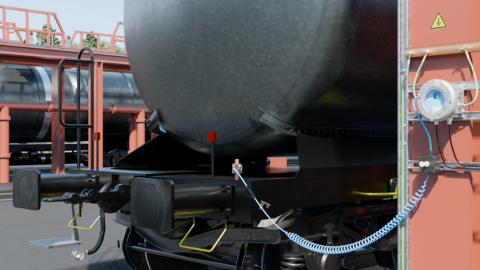
Grounding of railcars during loading and unloading operations
It should never be assumed that the connection to the rails themselves serves as grounding or a valid connection to a verified ground point.
NFPA 77 2024ed 12.4.2 states:
Many tank cars are equipped with nonconductive bearing and nonconductive wear pads located between the car itself and the trucks (wheel assemblies). Consequently, resistance to ground through the rails might not be low enough to prevent accumulation of static electric charge on the tank car body. Therefore, bonding of the tank car body to the fill piping is necessary to protect against charge accumulation.
The Association of American Railroads reinforces the need to ground rail cars via their Casualty Prevention Circular (CPC-1245) dated January 18, 2013, on Methods for the Safe Loading and Unloading of Non-Pressure and Pressure Tank Cars. Indicating in Section 1.7:
Tank car tanks containing flammable or combustible gases or liquids should be electrically grounded and bonded during loading and unloading operations. Grounding and bonding of cars carrying other commodities is also encouraged.
The use of a ground monitoring system will assist is establishing a connection to ground in order to electrically ground rail tankers before loading/unloading and for the duration of the process transfer. Exercising process control via interlocks offered by a ground monitoring system will further enhance safety in operations.