






Sources of electrostatic charge accumulation on vacuum trucks
Vacuum trucks and bulk chemical tanker trucks/tank trucks transferring flammable products require static grounding protection to mitigate the build-up of static electricity on the truck and equipment, like hoses, that are connected to the truck. If static electricity is allowed to accumulate, it will seek to discharge at the earliest opportunity.
The factor that contributes to an electrostatic spark discharge in truck vacuuming operations is the accumulation of static charges on some part of the transfer system. Due to the movement of charged material from the source location to the collection tank, electrostatic charges can accumulate on the lance, hose, hose connections, components within the tank, and the chassis of the truck itself.
In order to mitigate against a static spark discharge into a hazardous location during operations, the truck and its associated equipment and components should be bonded and grounded.
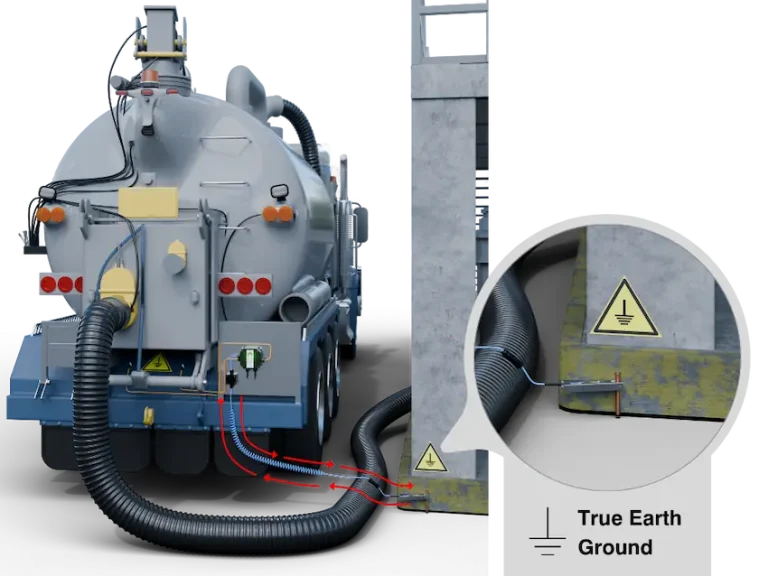
Grounding of vacuum trucks using static control systems
Vacuum truck operations will normally be conducted in remote locations on refineries and chemical facilities where “designated” grounding points may not be tested on a regular basis, are not accessible, or do not even exist.
Of the many recommendations outlined in American Petroleum Institute (API) 2219 “Safe Operation of Vacuum Trucks”, the most relevant instruction is to fully ground the truck by connecting it to “a designated, proven ground source” before commencing with transfer operations. The “ground source” describes an object with a low resistance connection to the general mass of the earth.
The standard also states the importance of confirming that the connection resistance between the truck and the designated grounding point is less than 10 ohms and that this resistance should be verified with the use of an ohmmeter (or a multi-meter).
Recommended Solution:

Guidance and standards
Wherever possible, Newson Gale adopts guidance on electrostatic hazards from standards publishing institutions that can help define the parameters for effective grounding and bonding in hazardous locations.
NFPA 77 2024ed Clause 7.3.1.6.1.1 states:
“If the purpose of the temporary grounding system is to dissipate static electricity, a total resistance of up to 1 Kiloohm (1000 ohms) in the ground path to earth is considered adequate.”
API 2219 5.5 Testing of Bonding and Grounding Static Lines states:
5.5.1 General
“All bonding and grounding static lines will be attached and tested before starting the loading or off-loading process. Testing will include (a) the testing of static lines at the point it is connected to the retractable reel, and (b) the testing of the retractable reel at the point it is connected to the vacuum truck.
A resistance less than 1 megohm [<1×10⁶ ohm] is traditionally considered adequate for static dissipation. For other purposes, such as grounding electrical systems, lightning protection, etc., much lower resistances are needed. For new equipment, a design target of 10 ohms is considered appropriate.”
5.5.3 Grounding
“Before starting transfer operations, vacuum trucks should be grounded directly to the earth or bonded to another object that is inherently grounded (due to proper contact with the earth), such as a large storage tank or underground piping. Grounding minimizes the electrical potential differences between objects and the earth in order to prevent a static charge. Grounding brings all parts of any system to zero electrical potential by allowing electrical currents to dissipate to earth (ground).
Retractable reels used for vacuum truck grounding cables shall be designed to provide electrical continuity between the grounding clamp or clip at the end of the cable and the vacuum truck regardless of the amount of cable extended. A safe and proper ground to earth may be achieved by connection to any properly grounded object.”
In IEC 60079-32-1 “Explosive atmospheres – electrostatic hazards, guidance”, the guidance with respect to the loading (or unloading) of vacuum trucks states the following:
8.8.4 Vacuum trucks
“Vacuum trucks should be connected to a designated site earth before commencing any operations. In areas where site earths are not present, i.e. where portable earthing rods are required, or there is doubt regarding the quality of site earths, the resistance to earth should be verified prior to any operation. When the truck is connected to a verified earth, the connection resistance between the truck and verified earth should not exceed 10 Ω for pure metallic connections or 1 MΩ for all other connections.
This requirement should be verified with a truck mounted earthing system or portable ohmmeter. The electrostatic suitability of the hoses used should also be verified in accordance with 7.7.3 or 9.3.3.”

The Earth-Rite® MGV is a truck-mounted grounding system that determines if the “ground source” it is connected to has a low resistance connection to the general mass of the earth. It has a user-friendly operator interface that indicates when the truck has a connection to earth.
The grounding system can be connected with a static grounding clamp to either buried structural metal work or to rods that are hammered into the ground.
When the operator connects the clamp to the object believed to have a low resistance path to earth, the grounding system immediately verifies whether or not the contact resistance of the object to earth is sufficiently low to dissipate static charges. This function is referred to as “Static Ground Verification”.
Once this connection to earth is verified, the Earth-Rite® MGV continuously monitors the connection resistance of the truck to the verified grounding point for the duration of the transfer process; this is referred to as “Continuous Ground Loop Monitoring”.
The connection resistance between the vacuum truck and the ground source must be maintained at 10 ohms or less for the duration of the transfer process. Both the Static Ground Verification and Continuous Ground Loop Monitoring checks need to be positive in order for the ground status indicators to change from red to green.
An additional form of safety redundancy can be introduced by interlocking the pump with the grounding system, so that if the truck loses its ground connection, the transfer process is shut down automatically, thereby canceling out the generation of electrostatic charges.
Note: If the electrostatic charging of liquids is high enough, there is a possibility that brush discharges could occur from the surface of an insulating liquid inside the tanker truck.
Grounding the tanker trucks/tank trucks to prevent static sparks, which are high-energy electrostatic discharges, may prove inadequate with respect to the avoidance of electrostatic brush discharges from the liquid itself*.
Care must also be taken to ensure that no ungrounded components on the tanker structure and no conductive items (e.g., empty cans or sampling cups) are floating on the surface of the liquid in case they discharge static sparks to other objects, like the inner wall of the tank, which should be grounded.
A thorough HAZOP of the process and material is advisable to rule out such concerns. Grounding of the tanker truck should be carried out, as this will mitigate against the risk of static sparks from the body of the tanker truck.
* Section 5-4.2 “Road Tankers” in “Avoiding Static Ignition Hazards in Chemical Operations, (AIChE).