

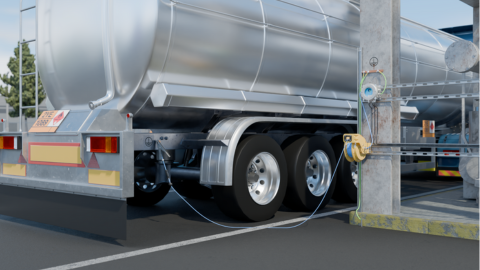
Grounding of tanker trucks
Wherever possible, Newson Gale adopts guidance on electrostatic hazards from standards publishing institutions that can help define the parameters for effective grounding and bonding in hazardous locations.
Getting Started: Tanker Truck Static Grounding FAQs
Truck grounding is the process of connecting a tanker truck to a verified earth point so static charge can dissipate safely. It’s a key control measure in HAZLOC environments where combustible liquids, vapors, or powders are handled. A robust solution uses an approved grounding clamp plus continuous monitoring — so operators get a clear GO/NO-GO status and interlocks can prevent product flow until grounding is confirmed.
To ground a tanker truck for loading/unloading, connect an approved grounding clamp to the dedicated ground point (a clean, conductive point on the truck which is electrically bonded to the tank) and verify the connection to the site’s designated ground before product flow starts. In HAZLOC operations, continuous monitoring is preferred so the system confirms the ground loop stays within the permissive threshold (10 ohms or less) throughout the transfer. The Earth-Rite® RTR system provide true ground verification plus clear GO/NO-GO indication to support safe procedures.
NFPA 77 Clause 12.2 “Bonding and Grounding” states:
Tank trucks should be bonded to the fill system, and all bonding and grounding should be in place prior to starting operations. Ground indicators, often interlocked with the filling system, frequently are used to ensure bonding is in place. Bonding components, such as clips, and the fill system continuity should be periodically examined and verified. For top loading, the fill pipe should form a continuous conductive path and should be in contact with the bottom of the tank.
7.3.1.6.1
Where the bonding/grounding system is all metal, resistance in continuous ground paths is measured to verify mechanical integrity. (See A.3.3.2.) Such systems include those having multiple components. Greater resistance usually indicates that the metal path is not continuous, usually because of loose connections or corrosion. A permanent or fixed grounding system that is acceptable for power circuits or for lightning protection is more than adequate for a static electricity grounding system. Static grounds should be made to the building steel, if possible. Grounding to power grounds or lightning protection systems is not recommended.
A.3.3.2 Bonding
A resistance not exceeding 10 ohms for copper wire or 25 ohms for stainless steel or other metals is typically found in practice. Higher resistances could indicate a lack of mechanical integrity.
In IEC TS 60079-32-1 “Explosive atmospheres – electrostatic hazards, guidance”, the guidance with respect to the loading (or unloading) of tanker trucks states the following:
7.3.2.3.3 Precautions for road tankers
The precautions for road tankers are the same as for fixed tanks (7.3.2.3.2) except for the use of different velocity limits as described in 7.3.2.3.5.4 and the following additional requirements:
1) Earthing and bonding:
a) The bonding resistance between the chassis, the tank and the associated pipes and fittings on the truck should be less than 1 MΩ. For wholly metallic systems, the resistance should be 10 Ω or less and if a higher value is found further investigations should be made to check for possible problems of e.g. corrosion or loose connection.
b) An earthing cable should be connected to the truck before any operation (e.g. opening man lids, connecting pipes) is carried out. It should provide a resistance of less than 10 Ω between the truck and the gantry’s designated earthing point and should not be removed until all operations have been completed.
c) It is recommended that the earth cable required in b) be part of a static earth monitoring system that continuously monitors the resistance between the truck and a designated earthing point on the gantry and activates interlocks to prevent loading when this resistance exceeds 10 Ω.
Recommended Solution:
Sources of electrostatic charge accumulation
When electrically insulating liquids and powders move through a system of pipes, filters, meshes, pumps, and so forth, the interaction with the equipment can charge the material as it moves through the system.
If the electrostatically charged material is transferred into or out of an ungrounded tanker truck/tank truck, the electrical potential (voltage) of the tanker truck can rise rapidly. If the voltage on the tanker truck exceeds the breakdown voltage of the surrounding atmosphere, then the risk of an incendive electrostatic spark is significant.
The breakdown voltage of air is in the region of 3 kV/mm, and if an ignitable gas, vapor, or dust atmosphere is present in the spark gap at the time of discharge, then ignition is very probable. Sparks can be discharged from the tank/chassis of the tanker truck, or components attached to the tanker truck, onto objects like hoses, filling pipes, loading gantry equipment, and operators etc.
Tank trucks capacitance
Because sparks from isolated metal objects have a high level of energy concentrated in a single discharge, all metallic parts of a tanker truck (chassis, tank, pipe fittings, and hose trays, etc.) should be bonded together with a resistance of 10 ohms or less (ref: per 1a above).
This should prevent electrical isolation of metallic parts of the vehicle that could otherwise accumulate electrostatic charge. What cannot be avoided, however, is the potential electrical isolation of the tank truck body during loading and unloading procedures.
The electrically insulating properties of tank truck tires could isolate the tank truck body from the general mass of the earth. When the tank truck is receiving or offloading insulating materials the metal body of the tank truck (chassis, tank body, etc.) can develop very high voltages.
By connecting the tank truck to the general mass of the earth, spark discharges from the body of the tank truck can be avoided.
Grounding tank trucks
Grounding the tanker truck means that we are effectively connecting the structure of the tanker truck to the general mass of earth. It is assumed that no metallic parts like valves, lids, etc. are electrically isolated (R > 10 ohms) from the main structure of the tanker truck. It is generally accepted that most of the resistance in the path to ground will be between the ground electrode buried in the soil and the layers of resistance present around in the soil to the general mass of the earth.
While a theoretical value of 1 megohm is often cited as the upper threshold at which static charge will flow to the mass of earth, the electrical connections from the tanker truck to the ground electrode should be 10 ohms or less. If the electrical resistance in the circuit is higher, there is likely to be loose or corroding connections in the path for the charges to “travel” to earth. If there are mechanical breakages at these points they could present as spark gaps in the hazardous location.
NFPA 77 clause 7.1.2 states:
“Ignition hazards from static electricity can be controlled by the following methods:
(1) Removing the ignitable mixture from the area where static electricity could cause an ignition-capable discharge
(2) Neutralizing the charges, the primary methods of which are grounding isolated conductors and air ionization
(3) Reducing charge generation, charge accumulation, or both by means of process or product modifications
(4) Operating outside the flammable range, which could include diluting or inerting the mixture
7.3.1.6.1. Where the bonding/grounding system is all metal, resistance in continuous ground paths is measured to verify mechanical integrity. (See A.3.3.2.) Such systems include those having multiple components. Greater resistance usually indicates that the metal path is not continuous, usually because of loose connections or corrosion. A permanent or fixed grounding system that is acceptable for power circuits or for lightning protection is more than adequate for a static electricity grounding system. Static grounds should be made to the building steel, if possible. Grounding to power grounds or lightning protection systems is not recommended.
A.3.3.2 Bonding. A resistance not exceeding 10 ohms for copper wire or 25 ohms for stainless steel or other metals is typically found in practice. Higher resistances could indicate a lack of mechanical integrity.”
13 Earthing and bonding (IEC 60079-32-1) states:
“By far the most effective method of avoiding hazards due to static electricity is to connect all conductors to earth. This will avoid the most common problem which is the accumulation of charge on a conductor and the release of virtually all the stored energy as a single spark, to earth or to another conductor …
…The total resistance between an earthed object and the ground is the sum of the individual resistances of the earth wire, its connectors, other conductive materials along the intended earthing path, and the resistance of the earth electrode (i.e. earth rod) to the ground.
Most of the resistance in an earth connection may exist between the earth electrode and the earth itself. This earth resistance is quite variable because it depends on the area of contact, the resistivity of the soil, and the amount of moisture present, temperature, etc in the soil …
13.2.2. Metallic items in good contact with earth should have a resistance to it of less than 10 Ω. Although a value of up to 1 MΩ is acceptable for static dissipation, values above 10 Ω may give an early indication of developing problems (e.g. corrosion or a loose connection) and should be investigated. It is important that all connections are reliable, permanent and not subject to deterioration.”
Note: If the electrostatic charging of liquids is high enough, there is a possibility that brush discharges could occur from the surface of an insulating liquid inside the tanker truck/tank truck.
Grounding the tanker truck/tank truck to prevent static sparks, which are high-energy electrostatic discharges, may prove inadequate with respect to the avoidance of electrostatic brush discharges from the liquid itself.
A thorough HAZOP of the process and material is advisable to rule out such concerns. Grounding of the tanker truck/tank truck should be carried out, as this will mitigate against the risk of static sparks.
Care must also be taken to ensure no conductive items (e.g., empty cans or sampling cups) are floating on the surface of the liquid in case they discharge static sparks to other objects like the inner wall of the tank, which should be grounded.
