






HAZMAT Grounding Applications for the Emergency Services
Emergency Services HAZMAT Grounding for Hazardous Spill Response
The static grounding and bonding applications outlined in this document offer a practical and flexible solution for responding to hazardous spills caused by overturned vehicles or tank railcars.
The application focuses on the need for bonding and grounding as part of the planned response, following the guidelines set by NFPA 470 Hazardous Materials/Weapons of Mass Destruction (WMD) Standard for Responders.
By following these recommended steps for verifying the ground point, bonding items together, and completing the operation, responding Emergency Services can help ensure the safety of people, and effectively manage hazardous materials (HAZMAT) at the same time.
In accordance with NFPA 470 20.4.1 (10) regulations, responders must “demonstrate grounding and bonding procedures for product transfer from tank cars, including the following:
Selection of equipment
Establishment of ground field
Sequence of grounding and bonding connections
Testing of ground field and grounding and bonding connections.”
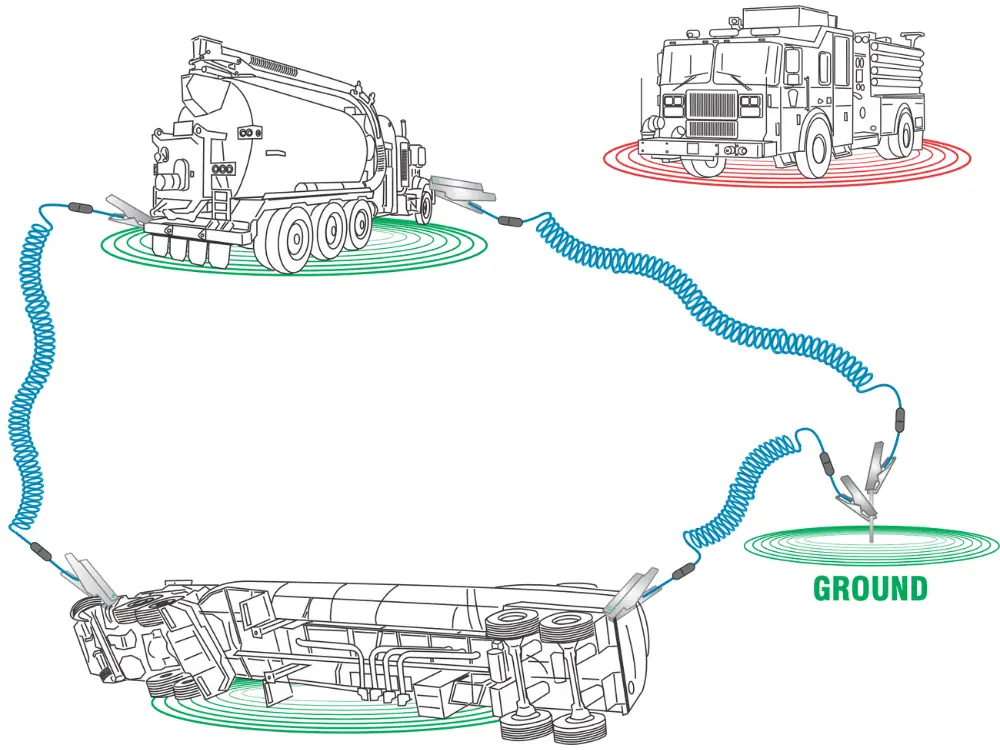
HAZMAT Grounding Application Steps
This type of application is unique because it is specific to a one-time event and requires adaptability to different scenarios, such as varying vehicles, locations, terrains, and hazardous materials involved in each HAZMAT situation.
This is where our products have been recognized as a valuable solution for the Fire and Emergency Services when tasked with responding to incidents involving hazardous spills.
REMEMBER: It is the responsibility of the end user, the responding Emergency Services, to provide a static grounding point and ensure that it is suitable for dissipating electrostatic charges.
Reference to NFPA 470 and NFPA 77 Code of Practice, API RP 2003, IEC TS 60079-32-1, CLC/TR: 60079-32-1, and any other local guidelines, standards, and recommended practices.
HAZMAT Grounding Solution:

Step 1. Verification of the ground point
To verify the quality of the ground point connection to the Earth, NFPA 470 Section: A.20.4.1(10) states:
“when grounding and bonding are performed, a ground resistance tester and an ohmmeter should be used. The ground resistance tester measures the earth’s resistance to a ground rod, and the ohmmeter measures the resistance of the connections to ensure electrical continuity. One ground rod might not be enough; more might have to be driven and connected to the first to ensure a good ground as resistance varies with types of soil.”
A certified earth ground resistance meter ensures that you have a resistance of ≤1000 ohms to Earth, and the ohmmeter ensures
that the resistance between the metallic object and the ground point is 10 ohms or less, and therefore capable of dissipating electrostatic charges safely to ground.
For bonding two items together, the Bond-Rite® EZ is recommended:
- Connect the Bond-Rite® EZ clamp to the object that needs to be bonded/grounded, specifically to the mass of the overturned vehicle/tank railcar.
- Connect the second clamp to the already established and Verified Ground Point.
- All objects involved in the transfer operation, including the overturned vehicle/tank railcar, external pump, vacuum truck, or receiving vehicle, stinger, etc., should be bonded and grounded back to the established Verified Ground Point. In this case, using the Bond-Rite® EZ. Once all the items are properly bonded and grounded, the transfer operation can commence.
If the bonded connection has a low loop resistance (10 ohms or less), the green LED on the Bond-Rite® EZ will flash, providing a visual indication to the responding Emergency Services of an acceptable condition between the bonded item and the established earth point. If the LED does not flash, the connection resistance is too high, and further work is required to establish a low-resistance bond connection.
As per the guidelines of IEC TS 60079-32-1, CLC/TR: 60079-32-1, NFPA 77, API RP 2003, and APR 2219, the grounding clamp should be fitted prior to any operation/transfers.
For Emergency Response services, this translates to establishing a sequence of bonding and grounding connections prior to commencing any operation product transfer(s), as per the NFPA 470 recommendation for competency requirements.
The Bond-Rite® EZ provides a visual indication to the responding Emergency Services of a well-established bond with a resistance of 10 ohms or less. This represents a significant improvement to many current practices used, as they now have a reliable method for confirming a successful and low-resistance bond between objects.
Refer to the Bond-Rite® CLAMP for installation and operating instructions.
After the transfer process is finished, all other operations are complete and the equipment put away, then remove all the clamps and cable assemblies, clean them, and stow them for future use.
Newson Gale recommends conducting an annual battery check and on-site verification (using two pieces of isolated metal) before beginning any HAZMAT operations.