







cCSAus Certificates - United States

IECEx Certificates - International

ATEX Certificates - Europe

UKCA Certificates - United Kingdom

CCC Certificates - China

KCs Certificates - South Korea


The Earth-Rite® MULTIPOINT II is a single grounding system that provides site operators with eight independent active ground monitoring circuits that can be used to monitor the ground status of eight discrete pieces of equipment used in hazardous locations. The monitoring unit consists of an array of eight pairs of green and red LEDs that indicate if the equipment is connected to a verified static grounding point.
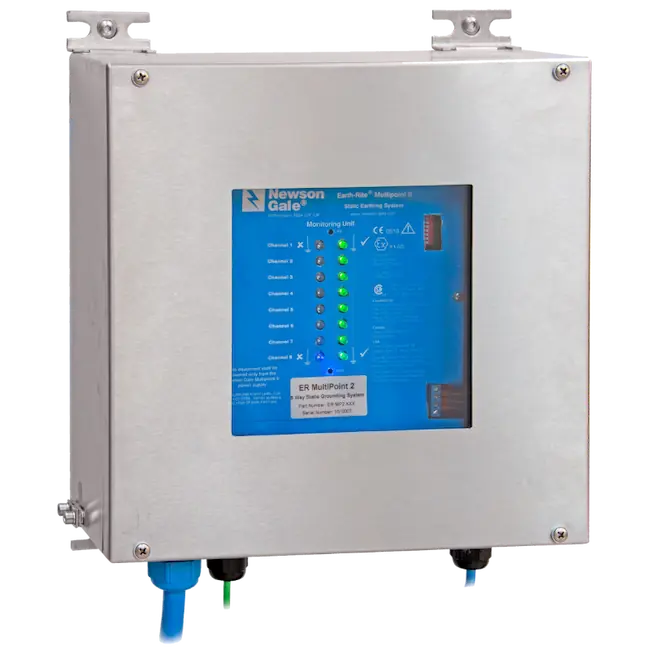
The monitoring unit utilizes the highest level of intrinsically safe circuits HAZLOC ‘ia’ to allow for the connection to equipment in locations classified as Class I, II, and III Division 1 (covering all gas, vapor, and dust groups). This removes any doubt regarding the location or existence of a Classified atmosphere at the point(s) where the Earth-Rite® MULTIPOINT II is connected to equipment. Temporary and semi-permanent connections can be made with a range of 2-core grounding clamps and connectors.
The monitoring circuit requires a resistance of 10 ohms or less before it will indicate a permissive condition to the operator supervising the procedure.
A simple traffic light method of “GO/NO GO” red and green LED indication provides process operators with a simple means of knowing that they can continue with the next step in their production process.
10 ohms is a benchmark resistance threshold defined in multiple best practice industry guidelines for the control of static electricity in hazardous locations. If the output contact driven by the corresponding monitoring circuit is active, and the ground status condition is permissive, a dry/volt-free SPDT relay will be energized.
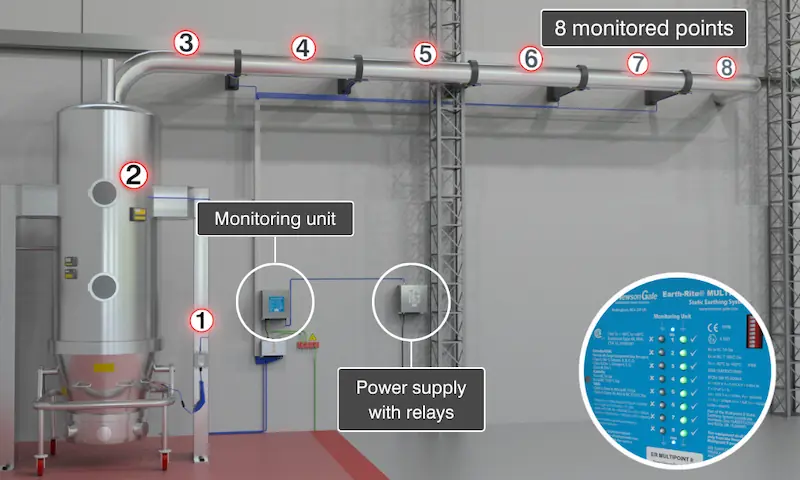
The monitoring unit is connected to equipment in the hazardous location via marshalling boxes that route the monitoring circuits to the points at which the system will be connected to the equipment requiring static grounding. If the equipment is in a position where it is difficult for operators to see the main LED array on the face of the monitoring unit, additional remote indicator stations mounted at the point of connection can be specified.
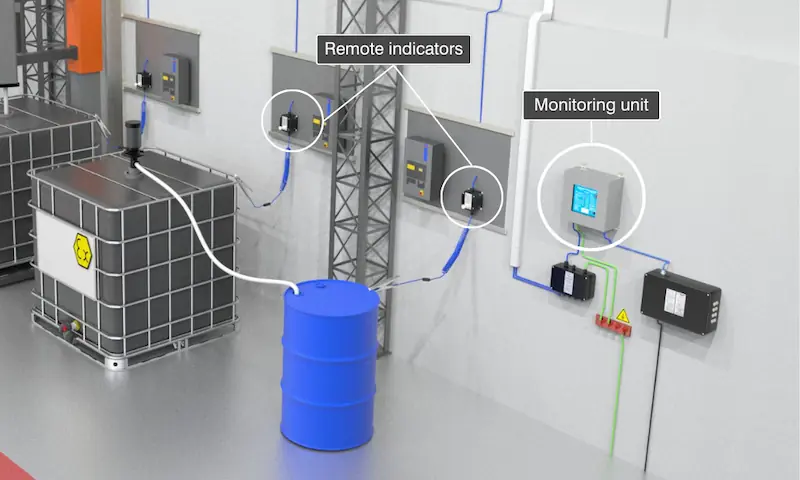
The remote indicator stations, fitted with a pair of red and green LED indicators, can be mounted in Class I, II, and III Division 1 locations and all gas and dust groups. The LEDs are powered by intrinsically safe HAZLOC ‘ia’ circuits with their enclosures classified as simple apparatus. When the Earth-Rite® MULTIPOINT II detects a connection resistance of 10 ohms or less to the equipment, the LEDs on the remote indicator station switch from red to flashing green. The flashing effect demonstrates that the Earth-Rite® MULTIPOINT II is continuously monitoring the ground circuit for the equipment requiring electrostatic grounding.
The channels for each monitoring circuit can be activated or deactivated via a set of DIP switche(s) located on the front panel inside the monitoring unit.
Intrinsically safe (IS) power is delivered to the monitoring unit by the power supply unit, which can be installed in a Class I, II, and III Div 2 location or a local non-hazardous location. The power supply unit also provides the dry/volt-free relays, which can be connected to external equipment like PLCs controlling the process or electromechanical equipment that can be activated/deactivated by the interlocks.
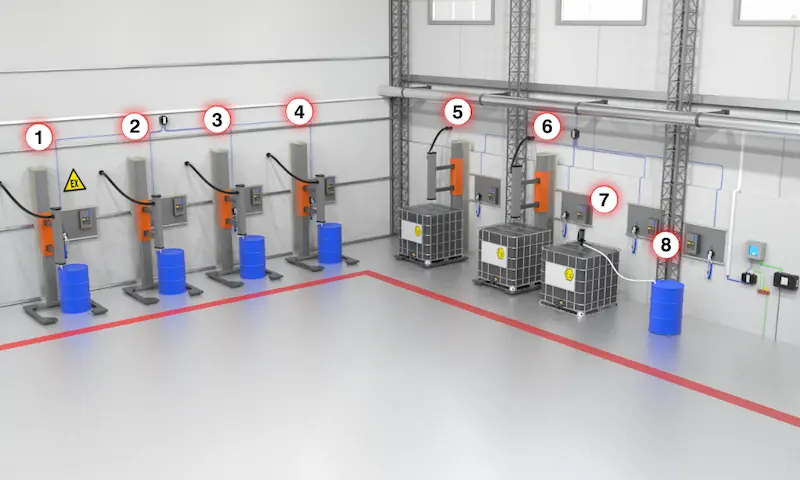
Each of the eight monitoring circuits has its own dedicated relay. This type of setup is particularly useful for multi-loading/unloading facilities, e.g., railcar loading terminals, that have PLCs controlling specific pump metering systems dedicated to the loading of each railcar.
If the specifier wishes to control external equipment, e.g., a single pump, that requires multiple pieces of equipment to be connected to ground prior to equipment activation, the relevant monitoring circuit can be “grouped” via a DIP switch located inside the power supply unit. For example, if a pump feeding three drums requires all drums to be grounded prior to filling, the relevant channels, e.g., 1, 2, and 3, can be grouped so that these circuits require a connection resistance of 10 ohms or less prior to the pump being activated.
All of the monitoring circuits can be grouped if the specifier wishes to control the process so that processing cannot take place, e.g., a fluid bed dryer system, unless all potentially isolated components are connected to ground.
Communication between the monitoring unit and power supply unit is provided via CAN-bus.