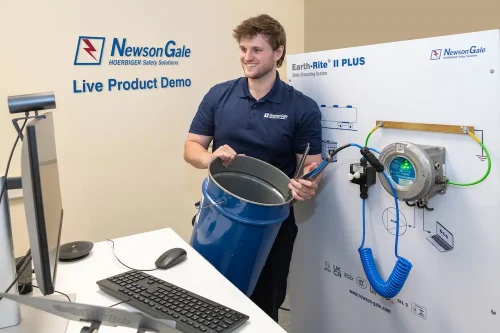
Provides a high-level overview of the key features and benefits of Newson Gale’s range of static grounding solutions.
Provides a high-level overview of the key features and benefits of Newson Gale’s range of static grounding solutions.



Tests the resistance of static dissipative footwear to ensure it meets specified safety standards/guidance (e.g., NFPA 77, EN ISO 20345, and IEC TS 60079-32-1).
Different versions to match the specific resistance ranges of footwear standards, ensuring versatile use across various operational needs.
Clear PASS (green LED) or FAIL (red LED) visual indication for quick and easy testing results.
Equipped with an audible alarm to alert personnel of PASS or FAIL results instantly.
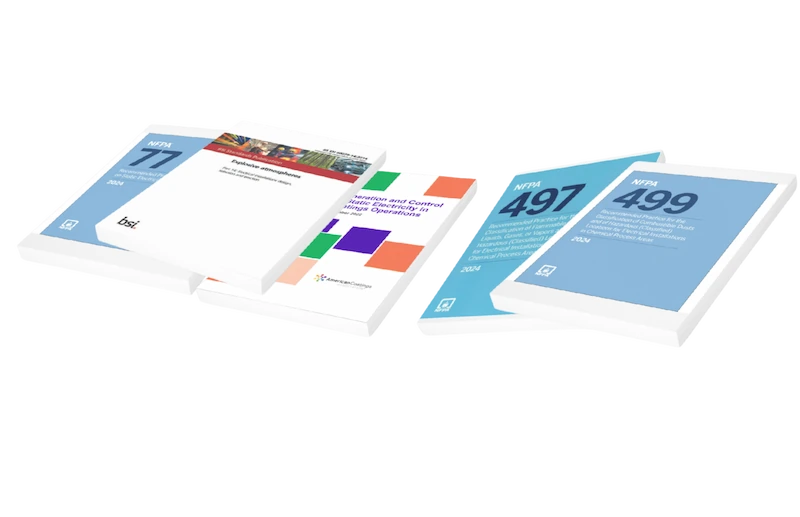
Learn more about Industry Standards and Guidelines relating to static electricity in explosive hazardous locations:
An SD (static dissipative) footwear tester checks whether SD-safe shoes are within the required resistance range so personnel grounding remains effective. Sole-Mate™ is Newson Gale’s static dissipative footwear tester: it measures footwear resistance against common guidance (e.g., NFPA 77 and IEC TS 60079-32-1) and provides a clear PASS/FAIL indication with an audible alarm. It can also be interlocked with entry systems to help enforce compliance.
To test SD shoes (static dissipative footwear), you measure their electrical resistance to confirm they’re providing the correct controlled path to ground. Newson Gale’s Sole-Mate™ tester makes this simple: step onto the test plate, follow your site procedure, and read an instant PASS/FAIL result with clear LEDs and an audible alarm. Different versions match common footwear resistance ranges and can be integrated with access control to support your ESD program.
International Standards recommend regular testing of static dissipative footwear. The Sole-Mate™ provides a time efficient and cost effective method of ensuring personnel operating in hazardous locations are wearing static dissipative shoes that are capable of mitigating electrostatic charge accumulation on their bodies.
Both NFPA 77, Clause 8.2.2. under Clause 8.2., “Conductive and Static Dissipative Flooring and Footwear”, and IEC TS 60079-32-1, Section 11.3 “Dissipative and conductive footwear” refer to an upper threshold of 100 meg-ohm (1 x 10⁸ Ω) resistance through the shoes.
EN ISO 20345, which is another safety footwear standard, specifies a resistance range of 100 kilo-ohm up to 1000 meg-ohm (1 x 10⁵ Ω up to 1 x 10⁹ Ω).
When specifying footwear testers it is important to know what specification the shoes are manufactured to so that the applicable resistance range is tested on entry to the hazardous locations.
For example, if shoes manufactured in accordance with EN ISO 20345 are tested on a footwear tester designed to test shoes at NFPA 77 and IEC TS 60079-32-1 levels, there is a strong possibility that the tester will fail the shoes.
Testing frequency should follow your site’s SD control plan, risk level, and applicable guidance — but many facilities test SD protective footwear at the point of entry (daily or each time personnel enter the controlled area). That’s because shoes can drift out of range due to wear, contamination, or damage. Sole-Mate™ supports routine checks with quick PASS/FAIL indication and can be integrated with entry systems to help enforce testing consistency.
Interlock capability with audible alarm or entry doors into the hazardous location.

Newson Gale has an extensive product range that can be tailored to your processes and the range of HAZLOC classifications at your location.
The most effective way to identify what is applicable for your operations is by speaking with our team. They will provide in-depth information on the products, features and how the range of options can be tailored to your needs.
The Break Away Connector (BAC) is designed to address drive-offs during tanker trucks/tank trucks loading and unloading operations. To ensure safe product transfer, the grounding clamp must always be attached to the tanker truck before any other operations begin and securely stowed after all activities are completed. Failure to follow this procedure can result in the tanker truck driving off with part of the grounding system, causing costly damage and lengthy delays in restoring the safety system. The BAC mitigates this risk by allowing the grounding clamp and one-half of the connector to separate from the cable if a drive-off occurs, meaning only the clamp and connector need to be replaced to quickly restore the grounding system.
The Universal Resistance Tester (URT) is designed to provide users of Newson Gale Bond-Rite® static grounding systems with a means of testing the permissive resistance range on a regular basis.
The easy-to-use tester consists of a pair of rotary switches that enable a competent electrical person to check the resistance level at which the grounding system should be working and conduct a PASS/FAIL test at the required setting.
The Earth-Rite® II MGV Tester is a capacitance resistance tester (CRT) designed to have the same electrical characteristics as a tanker truck and provides engineers with a means of checking that the Earth-Rite® II MGV undergoing installation is permissive when it detects these characteristics.
The tester is connected to the Earth-Rite® II MGV system and its grounding point, and when activated, the Earth-Rite® II MGV’s LED indicators change from red to green, confirming that the Tanker Truck Recognition and Static Ground Verification checks are functioning as intended.
The CRT is highly recommended with a minimum of one per site.
• Required for system commissioning and routine service checks
• Easy to use with simple PASS/FAIL condition
Newson Gale’s R-series of static grounding reels offer Hytrel® cable housed on automatically retractable cable reel.
An optional stowage point is available for the VESX50-IP 2 pole magnetic grounding clamp. It allows the clamp to have a designated stowage point close to the item of ferrous metal based plant that the operator can use to stow the clamp safely when it is not in use.
Cen-Stat™ is a range of brightly coloured cables specially designed for applications in industrial and hazardous locations. Cen-Stat™ cables are based upon Hytrel® that combines the flexibility of rubber with the strength and process flexibility of thermoplastics.
Cables made from Hytrel® are mechanically resilient, have a wide working temperature and are resistant to a wide range of chemicals, as well as strong and durable.
The Cen-Stat™ range of FM and ATEX approved static grounding clamps and systems are designed to operate in the harshest hazardous locations. The certifications achieved by our range of clamps and cables benchmark their ability to establish and maintain good electrical contact with equipment requiring static grounding and bonding protection.
Equipment specifiers can order the Bond-Rite® CLAMP with 2-pole Cen-StatTM cable on standard spiral lengths of 10 ft (3 m), 16 ft (5 m), 32 ft (10 m) and 50 ft (15 m) of cable.
The spiral cable retracts when the clamp is not in use, ensuring the cable is neatly stowed and safely out of the way.
The Universal Resistance Tester (URT) is designed to provide users of Newson Gale Earth-Rite® static grounding systems with a means of testing the permissive resistance range on a regular basis.
The easy to use tester consists of a pair of rotary switches that enable a competent electrical person to check the resistance level at which the grounding system should be working and conduct a PASS/FAIL test at the required setting.
With this assembly operators tasked with grounding mobile process equipment will have a dedicated grounding point to attach the easy-to-use screw thread connector. The ‘plug-and-play connector can interface with all Newson Gale 2-core systems to provide ground monitoring capability on a wide range of mobile processes and equipment where generic grounding clamps cannot be used. The conical shape design aids in the reduction of powder deposit buildup over time and aids in clean-down operations.
A quick and easy-to-use grounding kit that may be swiftly deployed in an emergency or combustible material transfer operations where pre-existing designated grounding points are not available or accessible.
The portable grounding kit combines multiple shortened grounding rods (14 inches long) with surface wire grounding techniques to provide acceptably low resistance for static grounding requirements in field operations.
The flexible array of interconnected grounding rods is inserted into the soil at specified intervals to maximize the ability to safely dissipate static electricity from mobile trucks, service vehicles, and other equipment.
Static Grounding Canvas Kit Bag for Portable Grounding Kit and Cen-Stat™ Clamps, Assemblies, and Tools.
The strobe light is mounted in an elevated position and when the equipment is correctly grounded, flashes continuously informing personnel that a transfer process is underway and is protected from the static hazard. The strobe light can be used in conjunction with this product.
Designed for operating environments subject to intense sunlight, the ERII Sun Shield protects against direct sunlight hitting the indicators on the static grounding system.
The Sun Shield casts a shadow over the indicators during peak sunlight hours so that operators can easily view the ground status indicators. The shield is constructed from stainless steel and can be fitted to any installation in a matter of minutes.
The IS Switching PCB is an additional circuit board added to Newson Gale system enclosures, enabling users to directly interface with, and switch, intrinsically safe circuits without the need for additional equipment. The IS Switching PCB is designed not to affect the IS signal’s electrical parameters and is compatible with this product.
The retractable cable reel is supplied for grounding system installations where customers want to ensure the grounding clamp and cable are returned to the static grounding system by operators and drivers on completion of the material transfer process. The reel can be used in conjunction with this product.
The Earth-Rite® II RTR Tester is a capacitance resistance tester (CRT) designed to have the same electrical characteristics as a tanker truck/tank truck and provides engineers with a means of checking that the Earth-Rite® II RTR undergoing installation is permissive when it detects these characteristics.
The tester is connected to the Earth-Rite® II RTR system and its grounding point, and when activated, the Earth-Rite® II RTR’s LED indicators change from red to green, confirming that the Tanker Truck Recognition and Static Ground Verification checks are functioning as intended.
The CRT is highly recommended with a minimum of one per site.
• Required for system commissioning and routine service checks
• Easy to use with a simple PASS/FAIL condition