






Newson Gale

Earth-Rite® II FIBC

Newson Gale’s dedicated Type “C” FIBC static grounding system

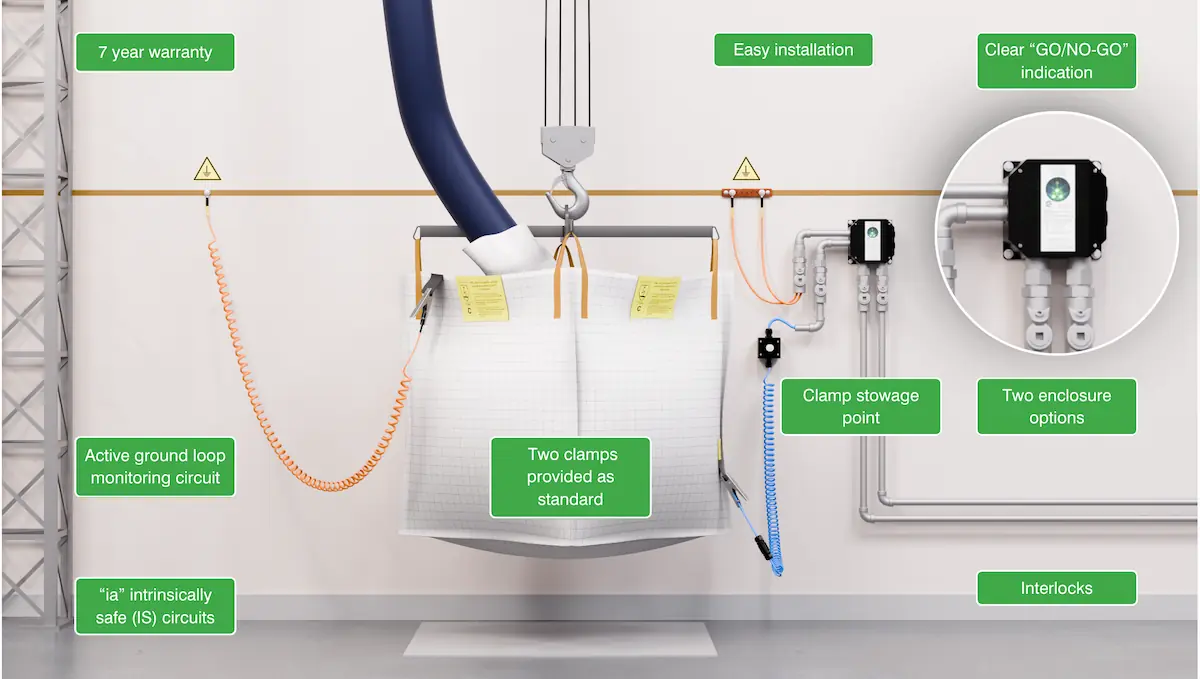
Earth-Rite FIBC Features

Datasheet Downloads

English-American
US
British-English
UK
Spanish
ES
French
FR
German
DE
Italian
IT
Chinese
CN

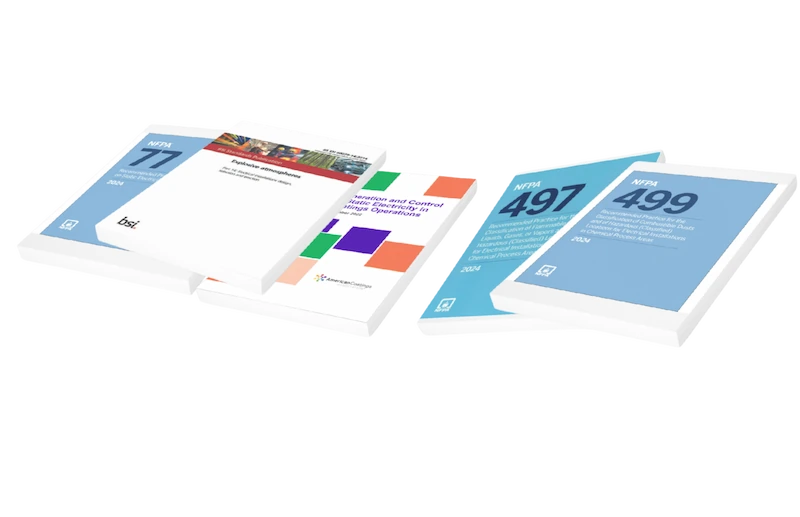
Learn more about Industry Standards and Guidelines relating to static electricity in explosive atmospheres:

Industry Standards and Guidelines
Universal Resistance Tester (URT)
Intrinsically Safe (IS) Switching PCB

Overview of the Earth-Rite® II FIBC

The Earth-Rite® II FIBC system actively monitors the resistance through Type C bags to determine if the conductive or static-dissipative (SD) structure of the bag is below the upper threshold of the 1 x 10⁸ Ω resistance level defined in NFPA 77, 2024ed, Section 16.6.6 “Electrostatic classification of Type C flexible intermediate bulk containers (FIBC)”.

See the Applications page for more information on this standard.

Constructing the bag of materials that make it “conductive” enables the bag to be grounded, thereby mitigating the risk of an incendive electrostatic discharge from the bag in the presence of a hazardous location. An added benefit of grounding the bag is preventing electrostatic shocks to personnel or other isolated objects.

Watch the video to learn more about the Earth-Rite® II FIBC.

Operation of the Earth-Rite® II FIBC

In line with recommended practice, it is advisable that plant operators follow a simple protocol of Clamp On First, Clamp Off Last (CoF/CoL). This should, wherever possible, be incorporated into the process operator’s SOP.

The following conditions must be satisfied before the Earth-Rite® II FIBC will indicate a permissive condition to process operators:

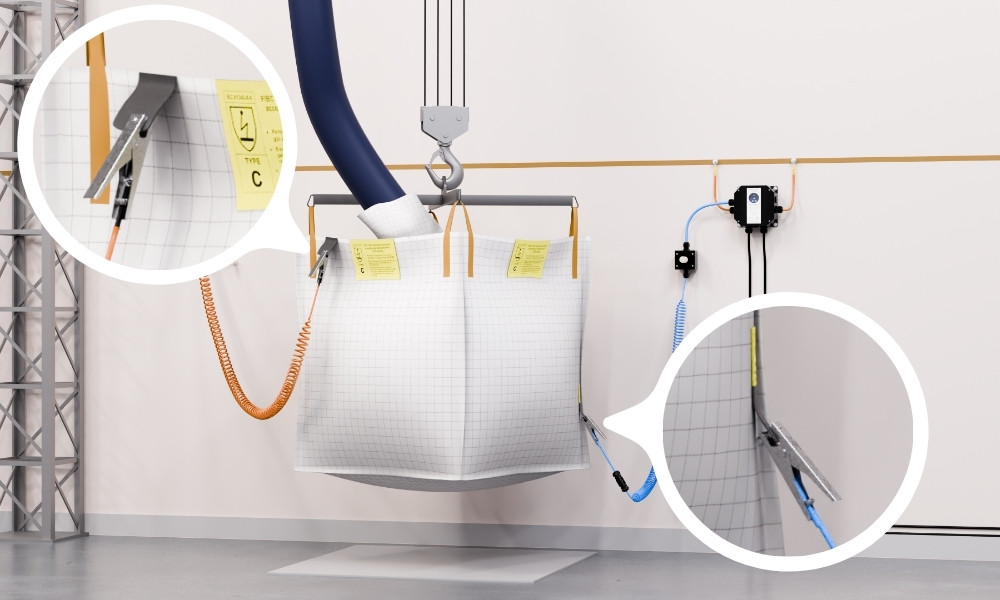
Close-up of the Earth-Rite FIBC grounding and monitoring clamps attached to a Type C bag
The monitoring and grounding clamps attached to the FIBC Type C bag

Intrinsically safe (IS) active ground monitoring circuit

To remove any level of doubt with respect to the hazardous location of the bag, the Earth-Rite® II FIBC system utilizes an intrinsically safe (IS) ground monitoring signal with the highest level of HAZLOC protection, which can be used in all gas, vapor, and dust classified environments, Class I, II, and III Div 1 locations. In addition to determining if the resistance through the bag is below the specified upper resistance threshold of 1 x 10⁸ Ω, the Earth-Rite® II FIBC system actively monitors the Type C bag’s connection to the plant’s verified grounding point.

This feature determines if the Type C bag has a monitored connection to a verified ground, which enables the dissipation of electrostatic charge from the bag for the duration of the filling/emptying operation.

There may also be occasions, e.g., after filling, where the Type C bag should continue to be grounded by the system to enable the migration of charge from high-resistivity materials within the bag via the conductive/static dissipative elements of the bag to ground. If this is the case, an SOP should be developed that incorporates a specified charge relaxation time for the material being processed.

The intrinsically safe ground monitoring circuit remains active for the duration of the bag filling/emptying process.

FIBC intrinsically safe Ex ia monitoring circuit

Two grounding clamps

Earth-Rite FIBC Type C static earthing monitoring clamp
Monitoring Clamp
The unique shape of the nylon serrated block, coupled with the rounded contact, allows the VESX45-F clamp to be applied to Type C grounding tabs located on Type C FIBC bags. The grip provides a firm, fixed connection to the tab without causing damage or compromising the continuity of the tab, increasing service life of the bag.
Note: Never attach the monitoring clamp and the grounding clamp to the same tab on the Type C FIBC bag.

The Earth-Rite® II FIBC system is supplied with a pair of grounding clamps as standard. There are several benefits associated with this feature.

To determine if the resistance of the static dissipative material of the bag meets the ≤ 1 x 10⁸ Ω resistance threshold requirement specified in NFPA 77, 2024ed, Section 16.6.6 it is more beneficial to direct the monitoring circuit of the Earth-Rite® II FIBC through the bag. If you only check the connection to the designated grounding point of the bag, via a single clamp, this would only indicate if the designated grounding point of the bag is static dissipative, as monitoring through the bag cannot be verified with a single connection.

The monitoring clamp directs the intrinsically safe ground monitoring signal from the Earth-Rite® II FIBC system to a designated grounding point on the bag. By imposing a return path for the monitoring signal through the bag, it provides a good indication as to whether the resistance through the bag is in line with the standard. If the static dissipative content of the bag is less than the specified threshold of ≤ 1 x 10⁸ Ω, the second clamp, called the “grounding clamp” channels the signal back to the Earth-Rite® II FIBC system, via the plant’s designated grounding point. Any electrostatic charge at risk of accumulating on the bag is transferred to ground via the grounding clamp.

The benefit of providing two clamps is that it enables a broader test of the static dissipative structure of the bag. Ideally with one clamp attached to the bottom of the bag and the other attached to the top of the bag, to verify if the designated grounding points on the bag are electrically connected to the static dissipative material of the bag (e.g., threaded filaments).

Earth-Rite FIBC Type C static earthing earth clamp
Grounding Clamp
The grounding clamp, VESX45-FE (a fully conductive variant of the VESX45-F), is specifically designed to provide a reliable ground return path back to the grounding network. Attach the grounding clamp onto the top grounding tab of the Type C FIBC bag. Ideally, position the clamp diagonally to the monitoring clamp to ensure optimal path coverage.
Note: It is always recommended to use the dedicated grounding clamp to provide reliable grounding of the bag.

The gripping pressure applied by the clamps to the bag’s designated grounding points, once they are connected by the operator, is sufficient for making good electrical and mechanical contact with the grounding points located on the bag. However, care should be taken to ensure that the cables are not overstretched (e.g., by selecting too short a length of cable) or do not become disconnected i.e., by hitting the bag or moving the bag in an aggressive manner to dislodge product which may have solidified inside the bag.

Multinational standard IEC 61340-4-4 also states that the bag’s lifting hooks, even if they are made of conductive or static dissipative material, cannot be used as fortuitous earth connection points for the bag, i.e., points that transit electrostatic charge from the bag to earth. The use of lifting hooks, in this context, can be avoided by providing a second clamp that can be attached to a separate designated grounding point on the bag.

As is the case with any electrical circuit, it is worth noting that the monitoring signal of the Earth-Rite® II FIBC will take the path of least resistance through the bag, hence it is virtually impossible to test all the static dissipative material from which the bag is constructed. Periodic testing of bags subjected to frequent use or contamination should be carried out in line with Clause 9 of the IEC 61340-4-4 product standard for FIBCs. The Type C bag manufacturer should be able to advise on recommended testing intervals.

Easy to operate

The design of the user interface focuses on simplicity and ease of interpretation. A positive or negative state is provided by a cluster of red and green LED indicators, which promotes a simple but effective traffic light principle of “GO/NO GO”, indicating if the process, in this case, bag filling or emptying, can take place.

When the correct resistance threshold is achieved, the three green flashing LEDs indicate that the system is actively monitoring the resistance through the bag and the bag’s connection to the verified grounding point throughout the process.

The operator activates the Earth-Rite® II FIBC system by simply connecting both clamps to the Type C bag. The clamps should be connected to designated points located at the bottom and top of the bag, respectively. Once connected, the operator will be able to observe if a permissive condition is indicated by the LED indicators. Interactions with switches, dials, calibration devices, or the interpretation of resistance meter readings are not required. If the flashing green LEDs are activated, the operator can move on to the next step of the bag filling/emptying procedure.

Output contacts

Two pairs of dry NO/NC contacts, or an optional single IS switching contact can be selected for controlling equipment external to the system. If an automated bag filling/emptying system is being used, the Earth-Rite® II FIBC system can be interlocked with the PLC controlling the process so that a permissive condition must be achieved in advance of the bag filling/emptying process taking place.

Please note that in an emergency shutdown scenario, e.g., if the connection to ground has been compromised during the bag filling/emptying procedure, the product may continue to flow into, or out of, the bag once the bag filling process has begun. This could lead to the accumulation of static electricity on the FIBC. If a HAZOP assessment highlights the potential for such a scenario to occur, additional measures may need to be put in place. For example, it may be possible to determine the charge relaxation time of the material and issue an SOP to operators so that they do not approach the FIBC during the specified time period. Site operators should retain the services of a static control consultant if this scenario could arise.

Installation of the Earth-Rite® II FIBC

Please note that a HAZLOC-qualified person is required to carry out the installation of HAZLOC-certified products. If you have any doubts with respect to the installation requirements of Newson Gale equipment in hazardous locations, one of our hazardous location experienced engineers will be happy to support you.

The Earth-Rite® II FIBC system is easy to install and does not require any calibration of the monitoring circuit at the point of installation. The system can be powered by 115v/230v AC mains power or 12v/24v DC power.

If the hazardous location is dust only, a static dissipative GRP enclosure can be selected for installation in a Class II Div 2 location.

If the atmosphere is classified as having the potential for the presence of both a combustible dust and vapor atmosphere, an Ex d enclosure can be specified, as this will satisfy the requirements for both gas and dust atmospheres. Please refer to the technical specifications below.

As the ground monitoring circuit is certified as intrinsically safe, with the highest protection level for gas, vapor, and dust locations, both grounding clamps can be used in Class I and II Div 1 locations where they will be in close contact with the bag and the potentially higher concentrations of dust and vapor atmospheres.

Please Note:

  • It is the site operator’s responsibility to provide the verified grounding point for the Earth-Rite® II FIBC system.
  • The Earth-Rite® II FIBC must be installed as per the Newson Gale Instruction Manual.

Request a live product demo

Newson Gale has an extensive product range that can be tailored to your processes and the range of HAZLOC classifications at your location.

The most effective way to identify what is applicable for your operations is by speaking with our team. They will provide in-depth information on the products, features and how the range of options can be tailored to your needs.