

Level of Control
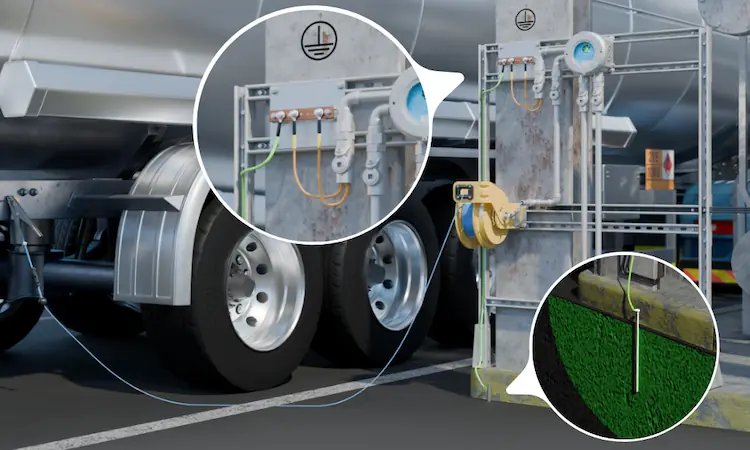
The primary function of static grounding systems is to provide a reliable path for static charge to be transferred from the equipment at risk of static charge accumulation to the general mass of the earth.
The transfer of electrostatic charge to the general mass of the earth limits the potential of the object to develop a voltage capable of discharging an incendive electrostatic spark.
The Bond-Rite® range offers a mid-level solution between basic clamps/cables and systems with visual indication and interlock capability.
The Bond-Rite® system provides confirmation to the operator of a low-resistance ground path by a high-intensity flashing green LED.
The Cen-Stat™ range offers a wide variety of different-sized clamps, spiral and straight cables, and retractable reels to suit your application. This helps keep your workforce and facilities as safe as possible.
Static grounding systems like the Earth-Rite® and Bond-Rite® ranges combine interlock control and visual indication to verified ground connection points and offer the highest levels of protection over electrostatic ignition risks.
Newson Gale’s approved 2-pole static grounding clamps ensure positive contact with the equipment to be grounded.
Our range of testing equipment, the OhmGuard® and Sole-Mate™, further increases safety for personnel and plant by verifying that Newson Gale grounding products are functioning correctly.
Testing Equipment
Best Practices for Grounding Mobile Equipment at Risk of Electrostatic Charge Accumulation
In a busy working environment, it is beneficial if operators have an established standard operating procedure (SOP) they can follow so they know when grounding of the process equipment at risk of charge accumulation has been established, and the next step in the process can commence.
This is of particular significance if the object(s)* at risk of charge accumulation are mobile and require temporary grounding connections.
A basic SOP of “Clamp On First, Clamp Off Last” should be followed wherever practical at all times.
* “object(s)” means any item of plant equipment that could be susceptible to electrostatic charging (e.g., drums, Ex IBCs, tanker trucks/tank trucks, railcars, hoses, etc.)
Regarding the “level of control” desired with respect to controlling the accumulation of static electricity, a good place to begin is by providing operators with a visual reference that confirms when the object at risk of charge accumulation is connected to the verified ground bar.
A visual reference, like a green flashing LED, informs operators that the connection to the verified ground bar has been established and that it is OK to proceed to the next step of the material processing operation.
The primary input that determines if the object has been grounded is the electrical resistance present between the object to be grounded and the verified ground connection. The grounding solution actively monitors the electrical resistance in the circuit between the object requiring static grounding and the plant’s verified connection to ground for the duration of the material handling process.
When specifying grounding solutions, it is important to remember who the primary interface is being designed for and used by. Operators should not be expected to work with indication methods that have multiple status settings or be expected to interpret real-time resistance readings.
Newson Gale advocates a simple and effective way of informing operators that a ground connection has been achieved either through a clear red/green “traffic light” format or a clear flashing green LED indication.
The majority of Newson Gale active grounding solutions incorporate flashing green LEDs for:
- Indicating that the grounding system is actively monitoring the resistance of the ground circuit.
- Their attention-grabbing effect.
- Operators who may suffer from red/green color blindness.
The grounding solution’s connection to the verified grounding bar is paramount to the safety of the system. Depending on the design of the intrinsically safe monitoring circuit, the connection will need either a high-integrity ground connection or a local verified ground connection.
Utilizing the design concept of galvanic isolation for the intrinsically safe circuit allows for the system to be installed to a local verified ground bar, often offering easier installation due to not having to install long cable lengths to a high-integrity ground.
The connection to the verified ground bar should also be actively monitored to ensure the electrical resistance present between the object to be grounded and the verified ground connection provides a passage for static charges to earth.
Having a grounding system that incorporates two connections to the verified ground bar allows the grounding system to continuously monitor the circuit through the ground bar during the process.
Should a rise in resistance over the grounding system’s maximum resistance parameter occur in these connections, either through loose connections or degrading over time, then the grounding system will not go permissive. This provides maintenance staff with an opportunity to investigate and identify the source of resistance (e.g., loose or broken connections) and rectify it to maintain the safety of the process.
The primary source of electrical resistance in many applications will be the connection of the grounding clamp (or other connection method) to the object requiring static grounding. The operations of many industrial processes will very often result in equipment being covered in product deposits, thick protective coatings, rust, or the build-up of dirt/grime over a sustained time period.
In order to achieve a 10 ohms or less connection, it is crucial that the grounding clamp is capable of penetrating such layers in a repeatable, robust, and reliable way. It is for this reason that Newson Gale pioneered the use of the hard-wearing metal tungsten carbide to produce teeth capable of penetrating connection inhibitors like product deposits, paint coatings, rusted surfaces, etc.
The sharpened profile of the teeth used in combination with a strong torsion spring housed in a heavy-duty stainless steel body enables their repeated use in harsh industrial environments. Not only are strong initial connections made to the equipment, but they are also maintained for the duration of the material handling process.
Although the magnitude of electrical current generated by electrostatic charging can be relatively small, normally in the micro-amp range, the resulting voltages can be very high and well beyond the breakdown voltage of air.
It is commonly quoted that a theoretical resistance of 1 meg-ohm to true earth will dissipate static electricity. However, due to the harsh industrial environments in which grounding equipment typically operates, and because most grounding applications require many repeated connections and disconnections to process equipment, the robustness and reliability of the grounding solution are the primary concerns with respect to intended performance.
For this reason, independent bodies such as the National Fire Protection Association (NFPA) and the International Electrotechnical Commission (IEC) recommend resistance levels of 10 ohms or less between the object requiring static grounding and the verified grounding point.
The reason for this is that resistances higher than 10 ohms in the circuit between the object and the verified grounding point, which has a connection to True Earth Ground, indicate potential compromise of the grounding circuit, like a poor initial connection to the equipment via the grounding clamp, or loose/corroding connections that could otherwise prevent the passage of static charges to earth.
In addition to the publications highlighted above, an electrical resistance of 10 ohms has often been cited in industry-specific guidelines and scientific journals as a good benchmark for indicating a reliable path to a verified grounding point.
In the vast majority of application settings, the object requiring static grounding will be made of metal, as will the verified connections to earth.

In addition to visual indication and active monitoring of the grounding circuit, an added level of active control is to interlock the grounding system with the process control circuits. This provides the added benefit of preventing the operation from beginning if the grounding system does not provide a permissive signal to the PLC/control circuit, thereby preventing the generation and accumulation of static charge†.
This is particularly beneficial for operations where large quantities of material are being processed (e.g., large containers/drums and Ex IBCs, tanker trucks, and railcars) as the systems controlling the movement of product could be controlled by PLCs and/or emergency shutdown systems, therefore reducing potential human error.
The methods outlined above are “active” grounding solutions. They provide a level of indication, monitoring, and control that informs the site operator as to whether a ground connection has been established and is being maintained, for the duration of a material processing operation.
As the grounding systems have active electronics, they all require 3rd party certification (like CSA, ATEX, IECEx, UKCA) for installation in potentially explosive atmospheres (a.k.a. hazardous locations). It is therefore important for specifiers, designers, and installers to determine the HAZLOC classification of the location where the active grounding system will be installed/operated to enable the selection of grounding systems that carry the appropriate HAZLOC certificates.
† assumes the system is installed in accordance with the Instruction Manual and the output contacts are used to prevent system startup and/or an emergency shutdown function.
At the lower end of the scale is the option of specifying combinations of grounding clamps with cables or retracting cable reels that provide none of the benefits listed above. In this case, we are describing “passive” grounding solutions where it is assumed that the connection between the object and the verified grounding point is performing the intended function of dissipating electrostatic charge to earth.

To compensate for the information gap provided to operators, it would be prudent for competent electrical persons to test the electrical resistance of the connection of these installations with ohm meters (certified for use in hazardous locations) on a regular basis to determine if there are breaks in electrical continuity that could otherwise impede the transfer of static charge to earth (dissipating).
Additional certifications (like FM Approval) can provide a higher degree of confidence in the ability of the clamp to establish and maintain a secure connection to equipment, but they will not completely compensate for the benefits provided by active solutions.


