









cCSAus Certificates - United States

IECEx Certificates - International

InMetro Certificates - Brazil

ATEX Certificates - Europe

UKCA Certificates - United Kingdom

CCC Certificates - China

KCs Certificates - South Korea

PESO Certificates - India


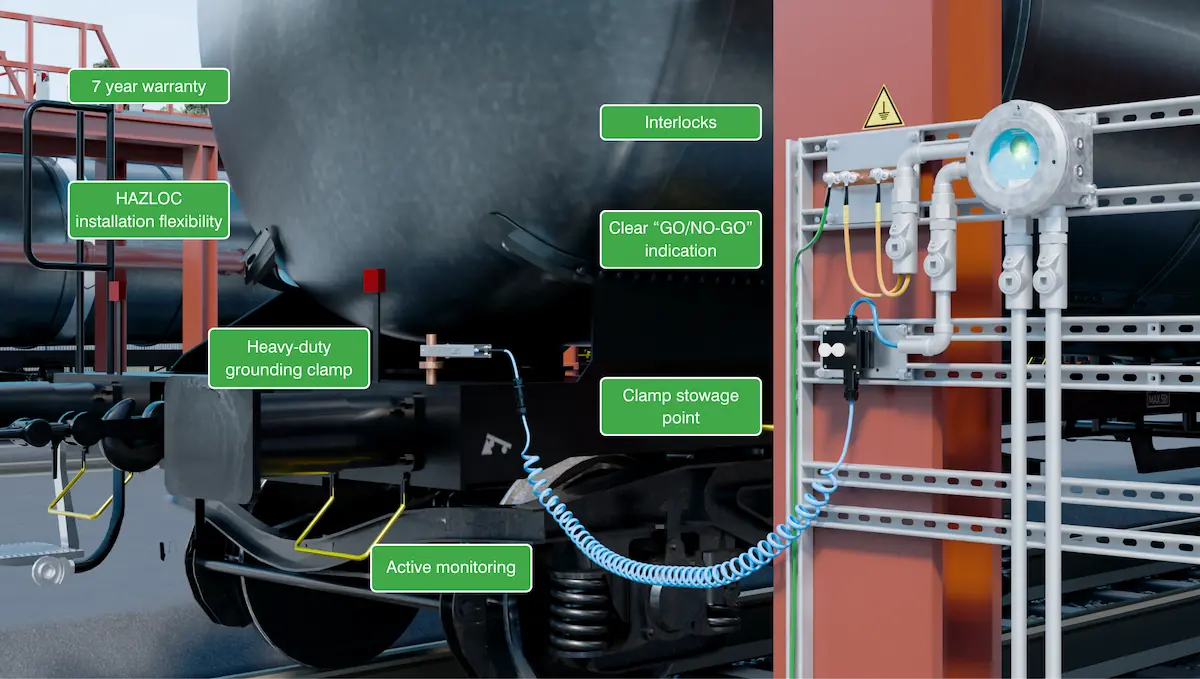
To help minimize interaction with complex system interfaces, the process operator does not need to interact with any settings or interpret any readings on the Earth-Rite® II PLUS system. By simply attaching the grounding clamp of the Earth-Rite® II PLUS to the object requiring static grounding, the system will automatically determine if the connection resistance to the object is 10 ohms or less. It achieves this by passing an intrinsically safe signal via the clamp teeth into the base metal of the object. If a connection resistance of 10 ohms or less is achieved, the signal returns to the Earth-Rite® II PLUS where the circuit electronics register a permissive condition.
An important point to note is that the Earth-Rite® II PLUS not only monitors the grounding clamp’s connection to the object, it also actively monitors its connection to the designated grounding point of the plant. Connection to earth via a local designated ground point and not via a high integrity electrical earth is possible due to the intrinsically safe circuit concept being achieved through ‘galvanic isolation’.
When the necessary inputs are in place, the Earth-Rite® PLUS switches from a solid red “NO-GO” to a flashing green “GO” LED indication. Site operators have the option of using either intrinsically safe or dry/volt-free, non-intrinsically safe contacts to interlock with the process equipment. This can be utilized to prevent the process from beginning unless a permissive state is provided by the Earth-Rite® II PLUS.

Please note that in an emergency shutdown scenario product may continue to move or flow after the equipment has been shut down. This could lead to the accumulation of static electricity on the object requiring static grounding if the grounding clamp has been disconnected. If a HAZOP assessment highlights the potential for such a scenario to occur, additional measures may need to be put in place. For example, it may be possible to determine the charge relaxation time of the material and issue an SOP to operators so that they do not approach the equipment/object during the specified time period. Site operators should retain the services of a static control consultant if this scenario could arise.
The operations listed above often result in equipment being covered in product deposits, thick protective coatings, rust, or the build-up of dirt/grime over a sustained period of time. In order to achieve a resistance of 10 ohms or less connection, it is crucial that the grounding clamp be capable of penetrating such layers in a repeatable, robust, and reliable way. It is for this reason that Newson Gale pioneered the use of the hard-wearing metal tungsten carbide to produce teeth capable of penetrating connection inhibitors like product deposits, paint coatings, rusted surfaces, etc.
The sharpened profile of the teeth, used in combination with a strong spring housed in a heavy-duty stainless steel body, enables their repeated use in harsh industrial environments. Not only are strong initial connections made to the equipment, but they are also maintained for the duration of the material-handling process.

It can be difficult to determine the boundaries between Division 1 and Division 2 classified locations, particularly in drum/IBC mixing and filling operations. This is why you will benefit from our certified grounding clamps, approved for use in all classified hazardous locations.
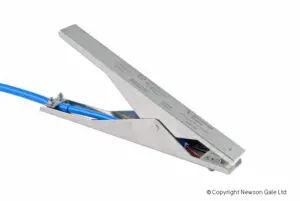
The grounding clamps have been tested and approved for:
- Clamp Pressure – ensuring the grounding clamp is capable of establishing and maintaining low resistance electrical contact with equipment.
- Electrical Continuity – ensuring the electrical continuity from the teeth throughout the grounding clamp is less than 1 ohm.
- High-frequency Vibration – ensures the grounding clamp is capable of maintaining positive contact when attached to vibrating equipment.
- Mechanical Pull Test – ensures the grounding clamp cannot be pulled off the equipment without the intentional application of force.